
When a simple dessert suddenly starts acting like a premium product
A glazed banana on a stick sounds as simple as it gets. A person sees a freezer, dozens of boxes, a familiar dessert, and makes a decision in literally a few seconds. In this category, a product either hooks you immediately or simply disappears among other packages.
This exact issue was the main challenge when working on the Boujee line for the German market.
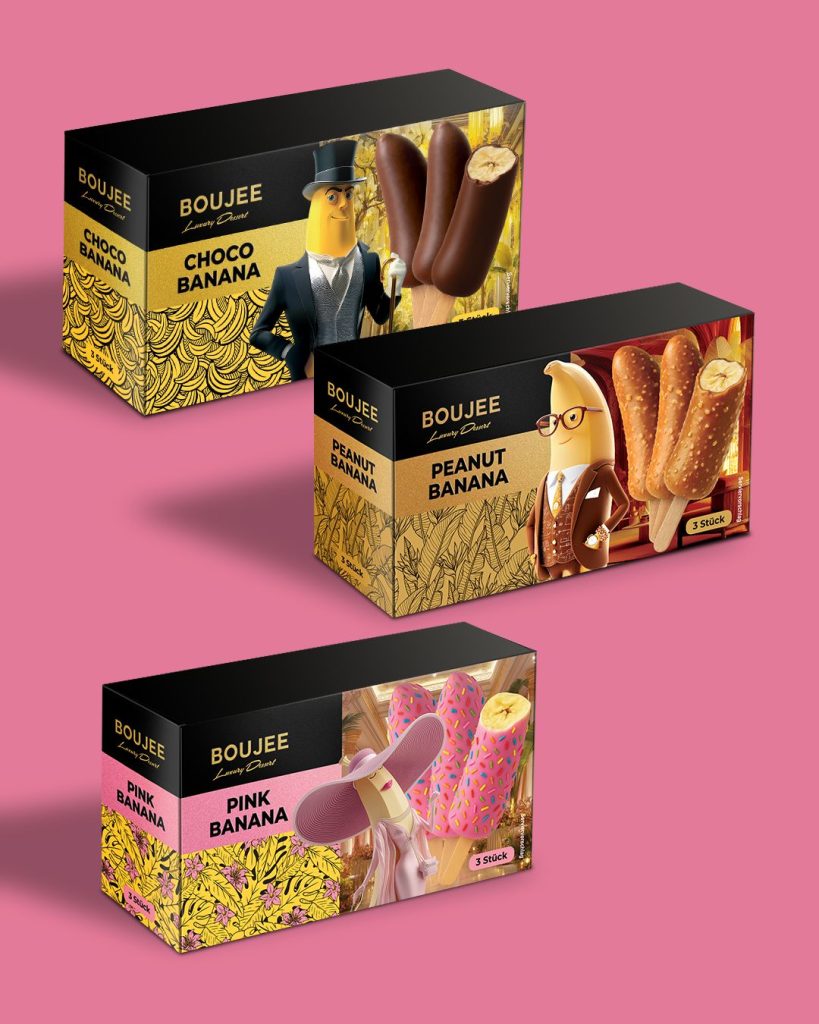
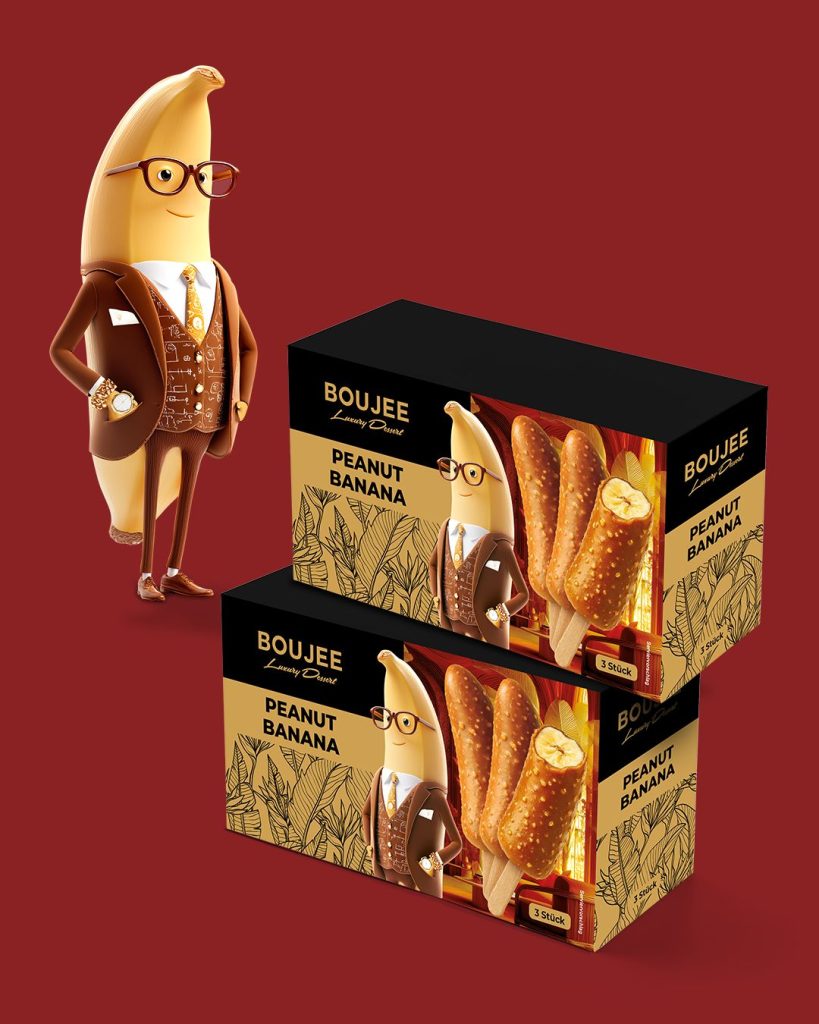
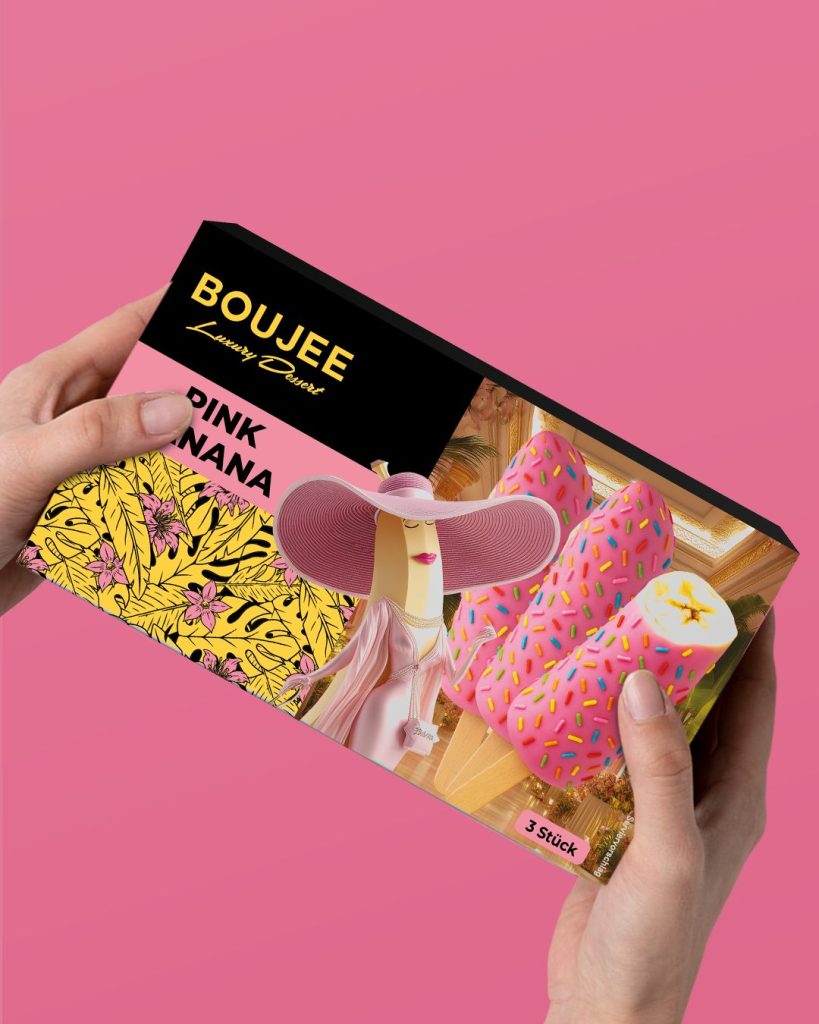
The photo shows more than just boxes with a frozen dessert. Here, every flavor acts as a distinct character. One looks like a reserved gentleman in an expensive suit. Another is warmer, slightly softer in mood. The third is almost a fashion character with a pink hat and dessert-like irony.
And what’s interesting is that the product itself hasn’t become more complicated. It’s still a glazed banana.
But the perception is completely different now.
Taste doesn’t always win in the freezer
There is one thing that sweets manufacturers often notice only after the launch. The product might be truly good. A normal recipe, good ingredients, an adequate price. But on the shelf, it looks like it could be replaced by anything else.
And then the strange questions begin:
- Why do people buy from competitors?
- Why didn’t the new product “take off”?
- Why is there seemingly enough advertising, but few repeat purchases?
Experience shows that sometimes the problem isn’t even the taste. The person simply didn’t feel the product’s character prior to buying it.
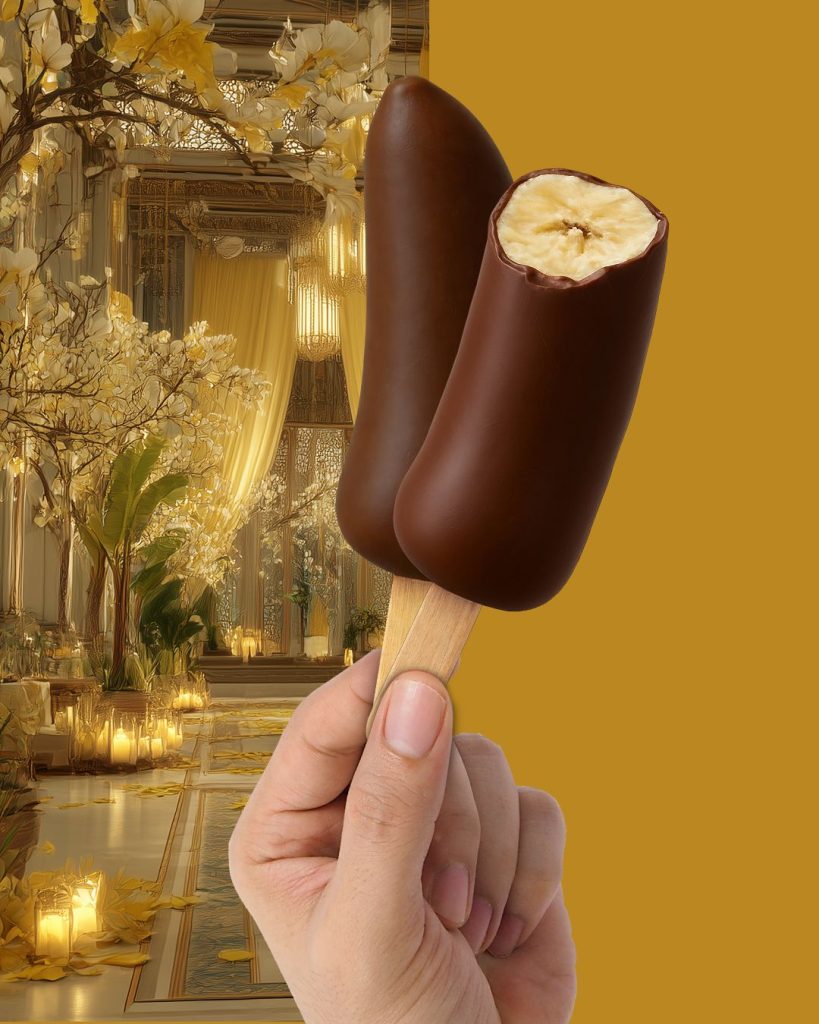
Boujee is built exactly on this nuance. Here, the packaging doesn’t just show the dessert. It sets the tone even before the buyer opens the box.
An expensive look isn’t created by gold color alone
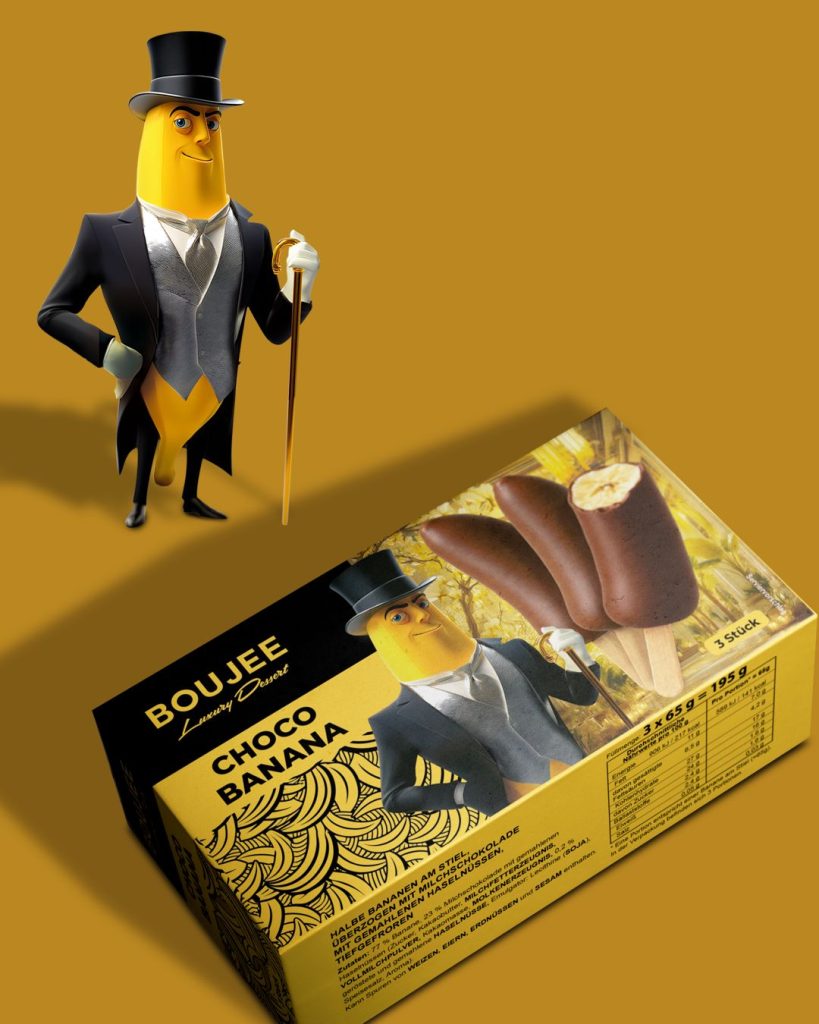
A black background and gold have long become a classic for premium goods. But these colors alone guarantee nothing. If you overdo it, the product starts to look artificial or too “luxury for the sake of luxury.”
What’s interesting about Boujee is something else. Here, the expensive style is mixed with a touch of self-irony.
The Banana gentleman in a tailcoat looks funny, but not cheap. Pink Banana looks glamorous, but without feeling like a caricature. Peanut Banana has a warmer presentation, almost like a dessert from a coffee shop where the barista knows all the regular guests.
Such things are difficult to explain in dry terms. It’s more about a sense of balance.
When the packaging is too serious, people don’t believe it.
When it’s too fun, the product stops looking high-quality.
But here, the balance was maintained very carefully.
Why do characters work better than just a photo of a banana?
In frozen desserts, everyone shows the product. Everyone puts a large render of the glaze, chocolate chunks, peanuts, or pink sprinkles.
And at a certain point, it all starts to look the same.
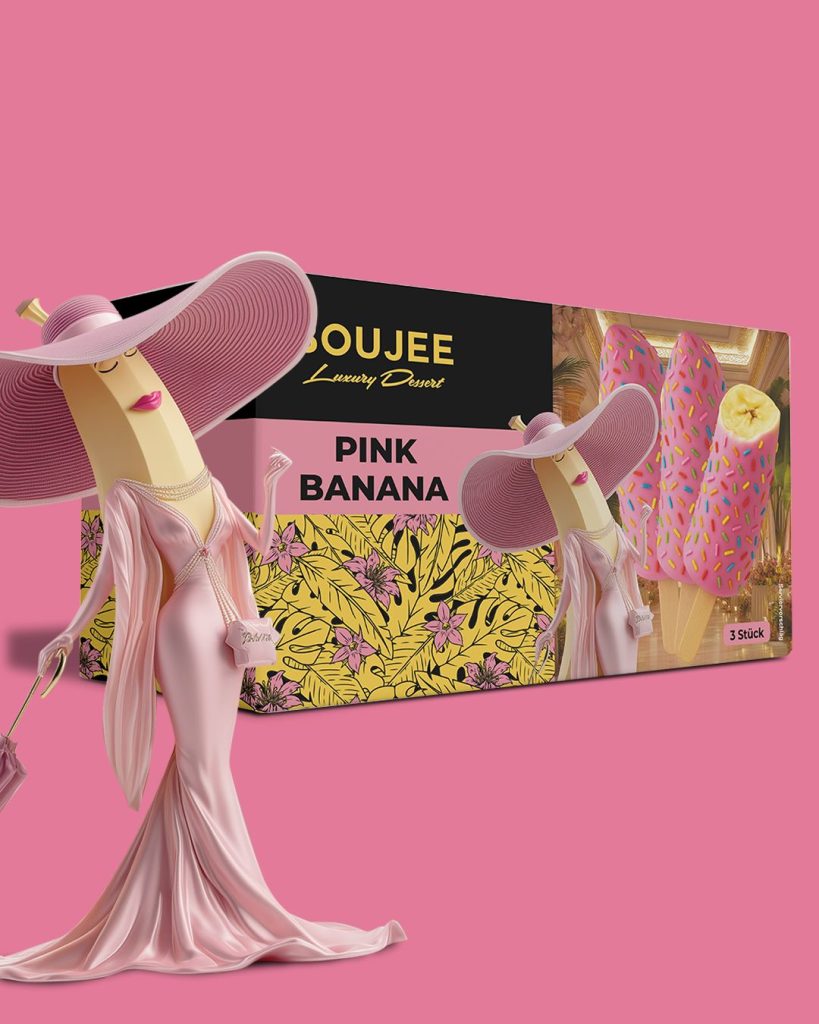
That is why in Boujee, the main focus was not just on the banana itself, but on the character of the flavor. A person remembers not just “that chocolate banana.” They remember the banana in a top hat or the pink lady in a large hat.
It sounds like a minor detail. But in real retail, such things work very powerfully.
Especially when a person walks past the freezer for the second time.
When the product is ready, but the packaging isn’t yet
The request for packaging design development very often comes at a strange moment. The product has already been manufactured. Sometimes even a batch is ready. There is a flavor, recipe, logistics, pricing, and agreements with stores.
And then it suddenly becomes clear that on the outside, the product looks weaker than it actually is.
And here the rush begins:
- Someone tries to add more gold.
- Someone asks to “make it look more expensive.”
- Someone just wants to enlarge the logo.
But the problem rarely lies in any single element.
In Boujee, the strength lies exactly in the system. In the colors, characters, composition, mood, product photography, and rhythm of the packaging. Everything works together.
Therefore, the boxes look cohesive even when the flavors differ significantly from one another.
The German market quickly senses falsehood!
It is particularly interesting how such products behave in the European market.
In Germany, the buyer reads artificiality quite quickly. If the premium style looks staged, it is noticeable almost immediately. If the packaging is overloaded, you simply don’t want to look at it.
Boujee looks confident, but without shouting.
There is no visual noise here. There is no feeling that the brand is trying too hard to impress. And this is perhaps one of the strongest aspects of this work.
Because in a real store, a person does not analyze the design professionally. They simply either trust the product or they don’t.
Sometimes the packaging literally explains the price
This is clearly visible in mid-range and premium segment products.
If the box looks cheap, the buyer automatically begins to doubt the price. Even if the dessert itself is good.
With Boujee, the packaging actually prepares the person for the price before the purchase. It creates the expectation of a more expensive product.
And here it is interesting that the design didn’t become minimalistic in a cold sense. On the contrary, there is a lot of life in it. There are characters, warm colors, decorative elements, textures, emotion.
It’s just that all of this is put together neatly.
A frequent problem that gets talked about only after the launch
Sometimes a manufacturer launches a new line, and then a few months later begins to realize that the product is difficult to scale.
One flavor looks normal. The second already stands out. The third looks like a completely different brand altogether.
That is why the system is more important than a single beautiful box.
In Boujee, every flavor has its own character, but the entire series reads as one family. This is important for the shelf, for advertising, for social media, and even for marketplaces.
By the way, in digital, such packaging works much stronger. The packaging development picked up on the TikTok trend of talking fruits from cartoons, so the characters easily transition into banners, animations, short videos, and ads on Instagram or TikTok. The brand gets more space for communication than just a photo of ice cream on a white background.
When a person buys not a banana, but a mood?
This is probably the main strength of such solutions.
Boujee sells not only taste. It sells a little mood. A little image. The feeling that this isn’t a random dessert from the freezer, but a product with its own character.
Sometimes this is exactly what many brands lack:
- Not just another logo.
- Not just another gold element.
- Not just another “premium” font.
But rather a normal emotion that a person can read in two seconds by the shelf.
That is why the request to order packaging design today increasingly concerns not only the box. Businesses are trying to find a way to look alive in a very noisy market.
And if the packaging makes a person smile for even a second or take a closer look, that is already the beginning of contact with the brand.
And from there, the product has a chance to be remembered.

